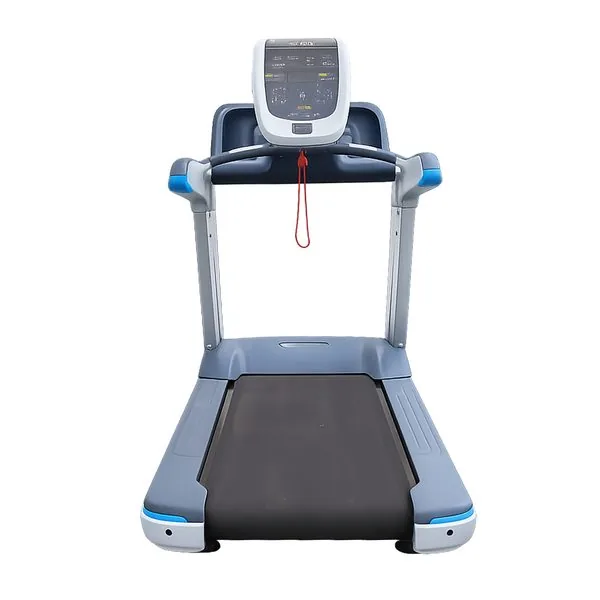
Ask three suppliers to quote you a "commercial treadmill" and you will probably receive three machines that share almost nothing except the word on the quotation. One is a 60 kg home deck wearing a bigger sticker. One is a genuine club machine designed for twelve hours of daily use. The third is something in between that the factory honestly cannot place — and it may be exactly what your project needs.
The word itself will not help you. There is no customs code for "commercial", and no authority checks who may print it on a spec sheet. What you can rely on is a real standard, a set of hardware differences you can measure, and one question that settles most decisions: how many hours a day will this machine actually run? Those three things are what this article walks through.
The standard that matters: EN ISO 20957 duty classes
Fitness equipment in Europe is classified under EN ISO 20957-1 into four duty classes, and this classification is far more useful than any marketing label:
- Class H — home use. Built for one to two hours a day in a living room, under a user who cares about the machine.
- Class S — studio use. Light commercial: personal training studios, physio clinics, small hotel gyms.
- Class I — institutional use. Schools, corporate gyms, apartment buildings, hotels with real daily traffic.
- Class A — professional and athletic use. Health clubs, performance centres, anywhere the machine runs most of the day.
When a supplier says "commercial", ask which class the model is built and tested to. A precise answer tells you the factory knows its own product. A vague one — "yes, commercial quality" — tells you something too.
Five places where the grades actually differ
1. Frame and total mass
A home treadmill is mostly sheet steel and plastic around a folding mechanism; finished weight sits between 60 and 100 kg. Club machines carry 3 mm wall square tubing, welded continuously instead of spot-tacked, and finished weights of 130 to 190 kg. Mass is not vanity. It is what keeps the deck stable under an 80 kg runner at 12 km/h in the ninth hour of the day.
2. The motor, and what its number means
Home machines use DC motors rated 1.5 to 2.5 CHP — continuous horsepower. Light-commercial machines push DC up to 3.0-3.5 CHP or step to small AC drives. Full-commercial machines run AC motors from 3.0 to 5.0 CHP with independent cooling, built to shed heat across a full day. The catch is that "HP" on a brochure usually means peak horsepower, a short-burst figure. More on that trap below.
3. Running belt and deck
Belt width is the first thing your members will notice. Home belts run 400-460 mm. Club machines are 500-560 mm, wide enough for a tired runner to drift without stepping off the edge. Underneath, home decks use a 15-18 mm board; commercial decks are 22-25 mm, multi-layer, and built so the running surface can be replaced without scrapping the machine.
4. Rollers and bearings
Roller diameter grows with duty class: roughly 40-50 mm at home level, 60 mm and above for club machines, with sealed bearings rated for tens of thousands of kilometres. This is one of the least visible and most consequential differences — a small roller spinning fast under a heavy runner generates heat, and heat is what kills belts and decks prematurely.
5. Cushioning
Home machines fit a few elastomer blocks and call it a suspension system. Commercial decks use multi-point, sometimes variable-density systems tuned so that a 60 kg walker and a 110 kg runner both land inside a sane impact range. On a genuine club deck you feel the difference in the third kilometre. On a relabelled home machine you feel it in the first.
The numbers, side by side
| Home (Class H) | Semi-commercial (Class S) | Full commercial (Class I/A) | |
|---|---|---|---|
| Designed daily use | 1-2 h | 4-6 h | 8-16 h |
| User weight ceiling | 110-120 kg | 130-150 kg | 150-180 kg |
| Motor | DC 1.5-2.5 CHP | DC 2.5-3.5 CHP or small AC | AC 3.0-5.0 CHP |
| Belt width | 400-460 mm | 480-520 mm | 500-560 mm |
| Deck board | 15-18 mm | 18-22 mm, replaceable | 22-25 mm, multi-layer |
| Roller diameter | 40-50 mm | 50-60 mm | 60 mm and up |
| Finished weight | 60-100 kg | 100-140 kg | 130-190 kg |
| Typical venue | Living room | Hotel, apartment, PT studio | Health club, performance centre |
These are common industry ranges, not laws — individual factories sit slightly either side of every line. Use them as a lie detector rather than a shopping list: if a machine claims Class A duty with a 430 mm belt and a 75 kg frame, the classification is doing more work than the machine is.
Why semi-commercial exists — and when it is the right answer
Full-commercial machines are over-specified for a large share of the projects that ask for them. A hotel gym on the fifth floor, an apartment building, a corporate wellness room, a personal training studio with two clients at a time — these places run their treadmills four to six hours a day, not twelve. Buying Class A hardware here means paying for capability you will never use, in freight and floor space as much as in price.
The opposite mistake costs more. Put a Class H machine into a hotel and it fails quietly — the belt starts slipping in month three, the controller goes in month six, and a guest-facing facility spends a season with a treadmill under an out-of-order sign. Run the same thought experiment with two identical 3.0 CHP machines, one in a five-star hotel and one in a private garage: the hotel unit will be on its second running belt within the year while the garage one is still on its first. Hours, not buildings, decide everything.
So count the hours before you choose the class. Estimate members per day, multiply by average session time, and add a margin for the evening peak. Under three hours, a good home-class machine is defensible. Three to six, buy semi-commercial. Above six — or if your members already outnumber your estimate — go full commercial and stop thinking about it.
A short word on curved treadmills
Curved machines sit outside this classification entirely. There is no motor — the user drives the belt with their own stride — so the duty class system, which is largely about surviving motor duty cycles, does not map onto them. A curved treadmill is a tool for HIIT zones and functional studios, priced and positioned completely differently from a motorised club deck. If a salesperson offers you one as a "commercial treadmill upgrade", they are changing the subject, not the class.
Three ways importers overpay on this exact decision
Buying Class A for a room that runs three hours a day. The machine itself costs more, the freight costs more, and the reinforced 380 V supply it may expect costs more again. The extra capability expires unused.
Buying the cheapest "commercial" quotation on the table. Two quotations can both say commercial and differ by 40%. The cheaper one is usually a Class H deck with better copywriting. Check belt width and finished weight first — they are hard to fake — and let the sticker argue with the scale.
Forgetting that a treadmill is also a freight item. A 190 kg machine in a wooden crate is a volume as much as a weight, and it still has to reach a fifth-floor machine room through a lift that was sized for furniture. Measure the route before you order the container, not after the crate arrives at the lobby.
Six questions to answer before you request a quotation
Suppliers can only match a machine to your project if you bring them the facts that matter. Have these six answers ready before you send an enquiry:
- Venue and user profile. A rehab clinic, a boxing gym and a residential tower hide different requirements behind the same word "gym".
- Real daily hours. Members multiplied by average session time. This single number decides the duty class.
- User weight distribution. Take the ceiling rating and keep roughly 30% in reserve; user weight in some markets runs heavier than buyers expect.
- Mains power. Export machines are wired for 220-240 V at 50 Hz or 110-120 V at 60 Hz. Confirm which your venue has. A container of 240 V machines arriving in a 110 V country is an expensive and slow lesson.
- Layout and spacing. Treadmills need clearance behind the deck for safety and around each unit for service access. It is easier to design this into the order than to retrofit it into the room.
- Consumables and spares. Running belts and decks wear out on every class. Agree the spares channel and part numbers when you order, not after something breaks.
The peak-horsepower trap
Brochures love peak numbers because they cost nothing to inflate. A motor advertised at 4.0 HP peak usually delivers 2.0-2.5 CHP continuously — and the continuous figure is the one that decides whether the controller survives your members' evening rush. Peak tells you what the motor survives for a few seconds. Continuous tells you what it survives for years.
The reliable way through: ask for the continuous rating, and if you want to go one level deeper, the current draw at 6 and 10 km/h under load. A genuine AC drive and a rewound DC motor give very different answers. Serious factories publish CHP openly and will send test data on request; evasiveness on a simple technical question should be read the same way as a missing factory address.
Matching the machine to the money
Everything above reduces to one line: hours per day decide the class, and everything else is negotiation. Over-specifying wastes budget that a second squat rack would have used better. Under-specifying costs you a machine, a month of downtime, and a certain amount of face in front of your members.
We build motorised and curved treadmills for studio and club duty at our own facility, and we would rather talk you into the smaller machine than watch it come back. Send us your venue type, expected daily hours and target market, and you will have a machine list with honest duty ratings and a quotation within 24 hours. Start the conversation here — or bring your floor plan and let us argue about it properly.