The most common scheduling mistake in gym equipment procurement is treating production time and shipping time as one number. They are two separate clocks, they run sequentially, and each has its own failure modes. A buyer who plans a club opening date around a single "45 days" figure from a supplier will usually be surprised, and the surprise tends to arrive the week before the grand opening.
Two clocks, not one
From the moment a deposit clears to the moment machines are standing on your floor, four stages run in order: production, inland haulage and export clearance, ocean transit, and import clearance plus delivery. Only the first is under the factory's control. The other three involve ports, carriers, customs and a trucking company, and none of them respond well to being hurried.
A realistic planning figure for a standard production run shipped from China to Europe or North America is 60 to 85 days door to door. Anything quoted below 45 days is either ex-stock or optimistic.
What FOB actually covers
Free On Board means the seller delivers the goods onto the vessel at the named port and pays all costs up to that point — inland transport from factory to port, export documentation, terminal handling and loading. From the moment the cargo is on board, risk and cost transfer to the buyer.
FOB is the most transparent term for a first order because every downstream cost appears as a separate line you can audit. It also protects you from a common pattern where a supplier quotes a low unit price and recovers margin through inflated freight.
Two details worth confirming in writing: the named port, because a factory in Dezhou shipping via Qingdao is quoting a different inland cost than one shipping via Shanghai, and whether the FOB price includes export packaging suitable for sea freight. Bulk-packed cartons that were never designed for container stacking are a recurring source of cosmetic damage.
FOB, CIF and DDP — and where the risk hides
| Term | Seller pays | Buyer controls |
|---|---|---|
| EXW | Nothing beyond making goods available at the factory | Everything, including export clearance |
| FOB | Inland transport, export clearance, terminal handling, loading | Ocean freight, insurance, import clearance, delivery |
| CIF | FOB plus ocean freight and minimum insurance | Import clearance, duties, delivery |
| DDP | Everything through to your door, including duties | Almost nothing — which is the problem |
CIF is convenient but the insurance attached to it is minimum-cover by default, typically Institute Cargo Clauses (C), which excludes a long list of perils. If you accept CIF, ask for Clauses (A) all-risks instead, and expect the premium to change.
DDP looks like the simplest option and is usually the riskiest. The seller is now responsible for customs classification and duty payment in a country whose rules it may not know well. Undervaluation is common in this space, and when customs later audits, the liability sits with the importer of record — which is you. For equipment that will carry your brand for ten years, controlling your own import entry is worth the paperwork.
FCL or LCL: where the crossover sits
Less-than-container-load shipping is priced per cubic metre and carries destination charges that are charged per shipment rather than per cubic metre. Those fixed charges — documentation, terminal handling, warehouse handling at destination — mean LCL stops being economical somewhere between 12 and 15 cubic metres.
For gym equipment the practical rule is simple. A small studio refresh of a few machines can move LCL. A complete floor of 30 machines or more should be FCL, where the fixed costs are spread across the whole container and there is no co-loading with other cargo.
LCL also introduces a physical risk that buyers underestimate: your cartons are consolidated with other shippers' goods, handled more times, and any damage claim is split among parties. Strength equipment is heavy and dense, which makes it vulnerable to being crushed by lighter but taller cargo loaded above it.
How many machines fit
These are planning figures based on export-packed volume, and every product line varies, but they are close enough to size an order:
| Container | Usable volume | Selectorized single stations | Commercial treadmills |
|---|---|---|---|
| 20GP | about 28–30 m³ usable | 15–20 units | 12–16 units |
| 40GP | about 58–60 m³ usable | 33–40 units | 26–34 units |
| 40HQ | about 68–72 m³ usable | 38–50 units | 30–42 units |
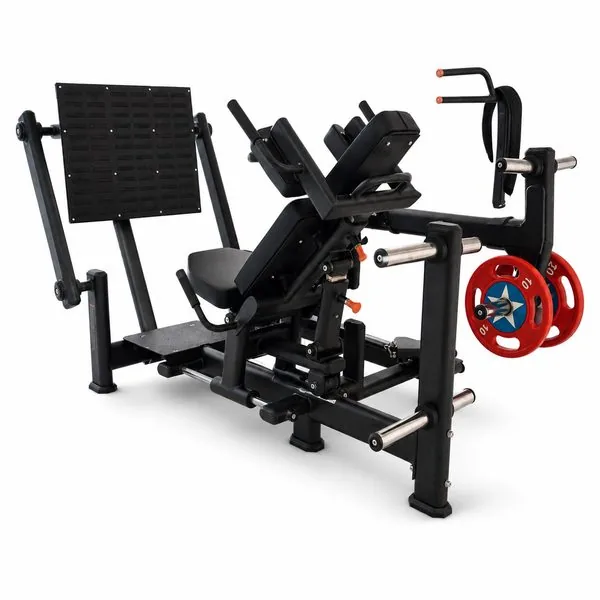
Note that selectorized strength machines are volume-limited rather than weight-limited, while plate-loaded machines and dumbbells hit the weight ceiling first. A 40HQ carrying plate-loaded leg presses will reach its payload limit before it runs out of space, and a container loaded to the weight limit is a different quotation and a different trucking plan.
Transit times by destination
Ocean transit from major Chinese ports, port to port, excluding inland legs and clearance:
- Los Angeles / Long Beach: 14–18 days
- New York (via Panama): 28–33 days
- Sydney / Melbourne: 16–22 days
- Jebel Ali: 22–28 days
- Rotterdam / Antwerp: 30–38 days
- Hamburg / Felixstowe: 32–40 days
- Santos, Brazil: 35–45 days
- Lagos / Mombasa: 30–40 days
Add 10 to 14 days for Europe-bound cargo while the Red Sea routing diversion is in effect, since vessels are taking the Cape of Good Hope. This is not a schedule detail you can negotiate away, and any forwarder quoting pre-diversion transit times for European lanes is working from stale data.
Loading practice that protects the cargo
Most transit damage to fitness equipment is decided before the vessel sails. Three habits prevent it. Heavy items loaded at the container floor, with lighter cartons stacked above and secured with airbags rather than left to settle. Steel frames braced against lateral movement, because a 900 mm frame that shifts during heavy weather will arrive with a bent upright. And a photo record of the loaded container, taken before the doors close, which is the single most useful document in any damage claim.
Ask for the loading photos as a routine deliverable. A factory that ships regularly will have them already.
Putting a timeline together
A realistic sequence for a 40HQ order of mixed strength and cardio equipment, produced rather than pulled from stock:
- Deposit to production start: 3–7 days
- Production: 25–35 days for standard finishes, 35–50 days for custom colours or branding
- Factory inspection and loading: 3–5 days
- Inland haulage and export clearance: 3–6 days
- Ocean transit: 15–38 days depending on lane
- Import clearance and delivery: 5–14 days
Total: 55 to 95 days. When a club opening is fixed and immovable, the useful lever is not asking for a faster ship, it is ordering earlier or splitting the order into an ex-stock first shipment for the cardio floor and a second shipment for the strength floor.
If you are working to a fixed opening date, send us the date and the equipment list and we will come back with a shipment plan that shows which items can move first.