A 30% deposit on a container of gym equipment is not a huge number compared with the order. It is, however, the exact point where you stop being a customer with options and start being a customer with a problem. Before that transfer, every question gets an answer within a day. After it, the same question can take a week, and the answer usually starts with "we are checking with the factory".
That is why the checks below happen before the wire, not after. None of them require you to fly to China, hire an inspector or read a certificate. Two of them take fifteen minutes on a phone call; together they filter out most of the suppliers who should never have made your shortlist. The rest are ordinary questions that a real factory answers easily and a trading desk struggles with.
The ten checks at a glance
| # | Ask for | Walk away if |
|---|---|---|
| 1 | Live, uncut video walkthrough | You get a polished film instead |
| 2 | Real-time location + gate sign | Location never matches the licence |
| 3 | Business licence, entity name | Invoice and account names differ |
| 4 | Current capacity and your slot | "Any quantity, any time" |
| 5 | A filled QC sheet from the last batch | Only blank templates exist |
| 6 | Jigs and WIP for your exact model | "We can supply everything" |
| 7 | A production sample and test method | Sample differs from line output |
| 8 | Public company registry check | New entity claiming a decade of work |
| 9 | Itemised quotation | One number, no specification |
| 10 | Payment terms, warranty wording, spares | 100% prepayment, verbal warranty |
Use the table as a score sheet. Sections 1 and 2 carry the most weight, so they get the most space below.
1. A live, uncut video walkthrough
Ask for a video call, not a video file. A file can be six years old, shot at somebody else's plant, or edited from ten seconds of forklift footage. A live call with someone walking through the workshop is much harder to arrange at short notice if the workshop does not exist.
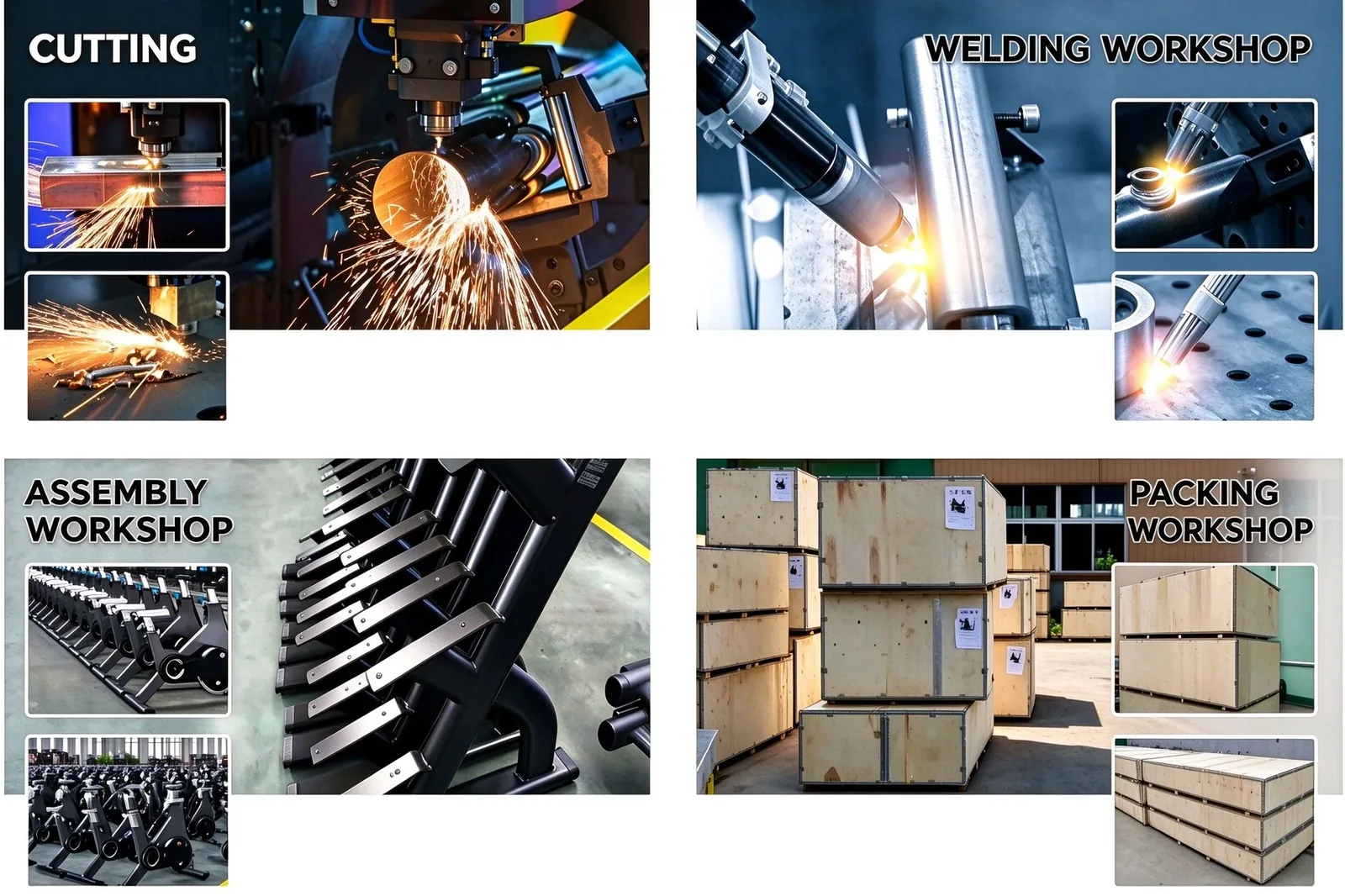
Here is the request, worded so it is easy to say yes to: "Could someone walk us through cutting, welding, assembly and packing on a call tomorrow, fifteen minutes, no preparation needed?" The "no preparation" part matters. A factory does not need to tidy up to show you its floor; a supplier borrowing one does.
How to run the call
Ask the person holding the phone to start at the raw material rack and walk forward in one continuous shot: tube cutting, welding stations, powder coating or paint, assembly, functional testing, then packing. No cuts, no switching to a second camera, no "let me send you a photo of that instead". Ask them to stop twice: once at a weld joint so you can see the bead up close, and once at the packing area so you can see how a finished machine is protected for a container. Ask a question mid-walk — "what model is this batch for?" — and listen for an answer that comes from the person on the floor rather than from someone relaying it from an office.
What you are actually checking
Not cleanliness. You are checking whether the four stages connect. A real plant has work in progress between them: cut tubes stacked near welding, frames waiting for coating, half-assembled machines with cables not yet routed. An empty, perfectly staged floor with finished machines in a neat row is a showroom, and showrooms do not have a production schedule. Pay attention to jigs — the fixtures that hold a frame in position while it is welded. They are boring, heavy, and almost impossible to fake quickly. Their presence tells you this factory builds this specific model repeatedly.
Red flags
"Our factory video is on our website." "The workshop is in a restricted area today." Three reschedulings in a row. A tour that starts and ends in the same office. A guide who will not step outside the meeting room. None of these proves anything on its own; together they tell you the deposit is premature.
2. Verify the location in real time
The most common trick in this industry is not a fake factory — it is a real factory belonging to somebody else. A trading company with a good relationship can walk a camera through a plant it does not own, and everything you saw in check 1 was genuine. The machines were real. They just were not your supplier's machines.
Two requests that are hard to fake
Share a live location. Most messaging apps can send a real-time location pin. Ask for it during the call, then compare the pin with the registered address on the business licence and with the industrial park the supplier has been naming. A pin that lands in an office tower in the city centre while the licence says a manufacturing estate outside town deserves one calm question.
Stand at the gate and say the date. Ask for a short handheld clip of the factory entrance sign, with the company name visible, your contact in frame, and something that anchors it to today — a phone showing the date and time, or that morning's newspaper. It sounds fussy. It is also the cheapest way to make a borrowed workshop useless as evidence. If the name on the sign is a different company, that is not necessarily bad news — plenty of legitimate suppliers work through a contract manufacturer — but you now know who actually builds your order, and you can put that name in the contract.
Red flags
A saved photo of a map instead of a live pin. A gate shot with the sign cropped out. "We have several workshops" offered before you have asked a question. A location that moves between calls. And the classic: a beautiful 4K corporate film that never once shows the front gate.
3. Business licence and the legal entity
Get a copy of the business licence and read three lines: the registered company name, the business scope, and the establishment date. Then check that the same legal name appears on the proforma invoice and on the bank account you are being asked to pay. This is not paperwork for its own sake — it decides who is liable if a container arrives with the wrong machines. China's public company registries make a licence easy to verify, and a supplier who hesitates to send a copy of a public document is telling you something.
You are also checking whether you are dealing with a manufacturer or a trading company. Neither is automatically better. A good trading partner can consolidate ten categories from three plants and save you weeks. But you should know which one you are paying, because it changes who answers when a weld fails in month eight.
4. Real capacity, and where your order fits
Ask how many welding stations there are, how many assembly lines, and how many containers of your category shipped last month. Then ask the question that gets a real answer: "If I confirm today, which production week is mine?" A factory with a schedule will give you a week and a slot. A desk without one will give you a lead time that sounds reassuringly short and stays identical in peak season and in February.
Red flag: "Any quantity, any time." Capacity is finite by definition; someone who has never met a limit has never booked a production line.
5. A filled-in QC sheet, not a blank template
Every supplier has inspection forms. Ask to see one filled in for the most recent batch, with a date, an inspector's name and actual measured values — tube wall thickness, weld checks, motor run test, load test, packing checklist. A blank form tells you the factory owns a printer. A filled one tells you somebody measured something and was willing to sign their name to it.
Ask where the three checkpoints sit: incoming material, in-process, and final before packing. If the only inspection happens at the end, problems are found after twenty machines have already been built the same wrong way.
6. Does this floor actually build your category?
Gym equipment is not one product. A plant that is excellent at selectorised strength lines may have no tooling at all for curved treadmills, wooden Pilates reformers or plate-loaded machines. On the call, ask to see the jigs and work in progress for the exact models on your list. If your order would be subcontracted, say so openly in the contract: which plant, whose QC, who carries the warranty. Subcontracting is normal; hiding it is the problem.
Red flag: "We can supply everything" delivered without a single photo of your product in production.
7. Test a sample before you book a container
Agree the test method in writing before production starts, not after a disagreement. For strength machines: weld bead consistency, powder-coat adhesion, weight-stack tolerance, cable and spring fatigue cycles, and whether the frame stays put under load. For cardio: noise and belt tracking at speed, and heat after a long run. Keep the approved sample as the reference unit — physically, or with dated photos of the exact details that matter — so "same as sample" means something six weeks later.
One honest caveat: a sample built by the sample room can be better than line output. That is exactly why checks 1 and 5 come before this one.
8. Check the company's legal standing
China's public company registries (Qichacha, Tianyancha and similar) show lawsuits, dishonest-judgement records, abnormal operations, equity freezes and how long the entity has existed under this name. It takes ten minutes and costs nothing. You are not looking for a spotless record — a factory that has been operating for fifteen years will have been sued at some point. You are looking for a pattern: recent enforcement actions, a name change six months ago paired with "ten years of manufacturing experience", or a registered capital that does not match the order you are placing.
9. Read the quotation line by line
An itemised quote names the Incoterm, the steel specification and wall thickness, the motor brand and continuous rating, the finish, the packaging method per item, mould or tooling costs if any, and the spares included. A single number with "commercial quality" attached is not a quote, it is an opening position. When two suppliers differ by 40% on the same machine, the gap is almost always hiding in one of those lines — usually wall thickness, motor rating or what is inside the crate.
Ask for the quotation in a spreadsheet with one row per model. It also becomes your reference document when the order changes, which it will.
10. Payment terms, warranty wording and spares
The common structure is T/T with a 30% deposit and the balance before shipment or against a copy of the bill of lading. A new supplier asking for 100% in advance is asking you to carry all the risk on the first order; if you accept, do it with a small trial quantity and a third-party pre-shipment inspection.
Get the warranty into the contract with its scope written down — frame, motor, wear parts, labour, who pays the freight on replacement parts — instead of a verbal "industry standard". Attach a spares list with part numbers and prices. Belts, decks, cables and upholstery wear out on every machine made; agree the channel now, when you still have leverage, rather than eighteen months later when you need a belt by Friday.
If you only have twenty minutes
Do checks 1 and 2 on one call, then ask for a filled QC sheet and an itemised quote by email. Those four things tell you more about a supplier than a folder of brochures. Everything else on this list can be done from your desk afterwards, with the deposit still unspent.
A note on refusals
A genuine factory is usually a little proud of its floor. People who build machines for a living tend to enjoy showing the welding jigs. So when a request for a fifteen-minute walkthrough turns into a week of excuses, the useful response is not suspicion — it is simply to keep your money and continue with the next supplier on the list. There is always a next supplier.
We build motorised and curved treadmills and strength equipment for studio and club duty, and we would rather answer these questions than avoid them. Send us your equipment list, destination and target market, and you will have a machine list with honest specifications and a quotation within 24 hours.