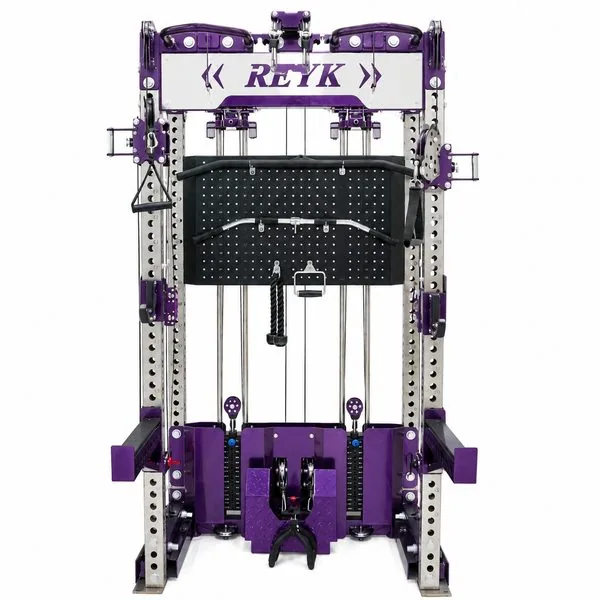
"Can you put my logo on it?" is a question every fitness equipment factory answers with yes. What varies enormously is what happens between that yes and the first shipment — and the difference between a modest customisation and a genuine OEM programme is measured in months and in minimum order quantities that can be ten times apart.
This article breaks customisation into levels so you can see exactly where a project sits, what it should cost in time, and which commitments are worth making on a first order rather than a third.
Two different words behind "custom"
OEM means you bring the design and the brand, and the factory manufactures to your specification. ODM means the factory already has the design, and you brand it. In practice, most first-time importers ask for OEM but actually need ODM with light customisation, and understanding which one you are buying changes both the price and the leverage you have in the negotiation.
The distinction matters most for tooling. In an OEM arrangement the mould is usually yours and should be contractually stated as yours. In an ODM arrangement the mould belongs to the factory and the same frame will appear under several brands in different markets, which is fine as long as you know it.
Five levels of customisation
Customisation is not a single yes-or-no. It sits on a ladder, and each rung has its own minimum and its own lead time.
Level 1 — Colour and upholstery
Frame powder coat changed to a specified RAL or Pantone number, and upholstery changed to a chosen material and stitch colour. This is the cheapest and most common request. It requires no new tooling, only a production slot for a different batch of powder and fabric.
Typical minimum: 20 to 50 units per model. Cost effect: roughly 3 to 8 percent above standard, driven mainly by powder minimum batch sizes and fabric minimum roll lengths. Lead time: 30 to 45 days.
Level 2 — Branding applied to the machine
Logo on the weight stack shroud, on the frame, on the seat back, or on the end caps. Methods are silk screen, laser etching on metal, or embossed plates. Laser etching is the durable option on steel and is what most commercial brands use; silk screen fades on high-contact surfaces.
Typical minimum: 30 to 50 units per model, often waived if combined with a colour change on the same order. Lead time: 30 to 40 days. Artwork requirements are simple — a vector file, plus confirmation of the marking area dimensions.
Level 3 — Packaging and documentation
Printed cartons, your own assembly manual, your own warning labels, and your own model naming convention on the serial plate. This is the level that makes a shipment feel like your product rather than a generic one, and it is the level most buyers skip.
Typical minimum: 100 to 300 units, because carton printing runs on a minimum sheet quantity. Lead time: 40 to 55 days. Beware of a common trap here: if the manual is translated, insist on reviewing the translation of the assembly steps and the safety warnings. A machine that assembles correctly but whose manual has an inverted step will generate support tickets from every customer.
Level 4 — Structural changes
Different seat shape, different handle geometry, a modified shroud, an extra adjustment position, a different weight stack increment. These require either modification of an existing mould or a new mould for the changed part.
Typical minimum: 200 to 500 units. Tooling cost: commonly USD 2,000 to 15,000 depending on part complexity, sometimes amortised into the unit price across the first order. Lead time: 60 to 90 days including tooling and sample approval.
Level 5 — New product development
A frame that does not exist yet. Industrial design, structural engineering, FEA, prototype, safety testing, then production tooling. This is a genuine development project rather than a purchase order.
Realistic timeline: 6 to 12 months to first production shipment, with two or three prototype rounds. It requires a proper development agreement covering who owns the design, who pays for tooling, and what happens if the programme is cancelled after tooling is cut. Companies that start here without a prior production relationship with the factory usually regret it.
MOQ by level, in one view
| Level | MOQ per model | Tooling | Lead time |
|---|---|---|---|
| Colour / upholstery | 20–50 | None | 30–45 days |
| Logo marking | 30–50 | Marking plate only | 30–40 days |
| Packaging / manual | 100–300 | Print plates | 40–55 days |
| Structural change | 200–500 | USD 2,000–15,000 | 60–90 days |
| New development | Negotiated | Full tooling set | 6–12 months |
What ODM really means when you buy it
Buying ODM means you are buying a design the factory has already amortised across other customers. The price is better, the lead time is shorter, and the design has usually been through production iterations that a new design has not. The trade-off is differentiation: the same frame may be selling in another country under another brand.
For most importers this is the correct starting point. A private label built on a proven ODM frame, with your colour, your logo and your packaging, gets you a branded product line in one container rather than one year. Differentiation can come later, on the two or three models that actually drive your volume.
What you should insist on in an ODM arrangement is a written statement of which markets and brands already carry the same frame. Not because it is a deal-breaker, but because it tells you whether your pricing is going to be undercut by an identical machine from a neighbouring distributor.
Timeline reality check
A buyer planning to launch a branded line for a trade show in nine months has room for Level 3 customisation. A buyer planning the same launch in four months has room for Level 1 and 2 only. A buyer wanting Level 4 needs to have started yesterday.
The schedule pressure is rarely in production. It is in sampling. Expect two rounds of samples for any structural change, each round taking two to three weeks including shipping, plus a week of your own review time. Three rounds is normal, and the third round usually exists because the first two were reviewed by email instead of by a person standing next to the machine.
Tooling ownership — the clause people forget
If you pay for a mould, the contract should state that the mould is your property, that it will be marked with your identifier, and that it must be returned or made available to another manufacturer on request. Without that clause, the tooling exists but you do not control it, and switching suppliers later means paying for it twice.
The same applies to design files. Ask for the CAD data and the artwork source files at the end of the project, not at the beginning — factories are reasonably protective of design files, but a paid development project should transfer them.
Branded goods need paperwork too
Customs authorities in most major markets can be asked to detain goods bearing a trademark that is not authorised. If your logo is a registered trademark, provide the factory with the registration certificate or a written authorisation, and keep that document with the shipping file. Factories that export branded goods regularly will ask for it anyway, which is a good sign.
Also confirm who is responsible for the model naming on the serial plate and the conformity documentation. A machine sold under your brand still needs a Declaration of Conformity, and the responsible entity named on it should be consistent with your arrangement — either the factory as manufacturer, or you as importer, depending on the market.
How to start without overcommitting
The sensible sequence for a first branded order is a colour and logo run on three or four high-volume models, shipped in one container, with stock packaging. That gets your brand onto a floor for a modest outlay and validates whether your customers care about the branding at all. Packaging and manual customisation follow on the second order, once you know which models are actually selling.
Structural changes belong on the third order or later, when volumes justify tooling and when you have field feedback about what to change. Buyers who invert this sequence — tooling on the first order, colour on the third — spend their capital on the wrong thing.
If you are planning a private label line, send us the models you are considering and the markets you sell into, and we will map each one to the customisation level it can support at your order volume.