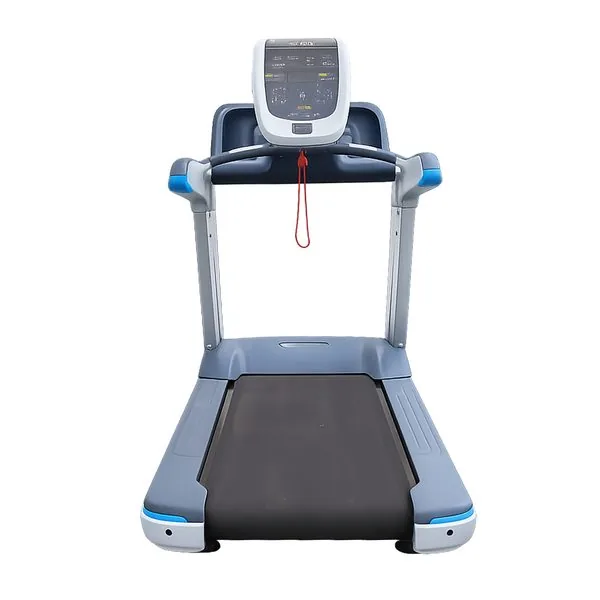
A commercial floor does not wear out on a calendar. It wears out on hours of use, and the same treadmill that needs a belt check every month in a 24-hour facility can go three months in a hotel gym that sees twenty guests a day. That is why a maintenance schedule written in "every quarter" is less useful than one written in "every hour of running, or every quarter, whichever comes first."
What follows is the schedule we would hand to a gym owner or a distributor servicing an installed floor. It is organised by equipment family, because the failure modes are genuinely different: a treadmill fails at the belt and the motor, a selectorized machine fails at the cable, a plate-loaded frame almost never fails at all but wears at the bushings. All of it is routine work that a trained staff member can do with basic tools — the point is not technical difficulty, it is that the tasks get done before a station goes out of service.
1. Set the cadence from usage, not from the calendar
Two numbers decide the real interval for any machine: how many hours per week it runs, and how many different people use it. High-traffic floors with unstaffed access wear fastest, because nobody adjusts anything. A destination studio with coached sessions wears more slowly but needs tighter inspection, since a cable failure during a class is a safety event rather than an inconvenience.
A workable convention is to classify each zone as light, standard or heavy. Light means under 30 hours a week of actual use; standard means 30 to 70; heavy means above 70 or 24-hour access. Then apply the intervals below and shorten everything by one step for heavy zones. This is more honest than assuming all equipment ages equally, which it does not.
2. Treadmills: the highest-maintenance item on the floor
Cardio machines carry motors, belts and electronics, and they account for most of the maintenance load in a commercial gym. The sequence below assumes a standard zone; heavy zones move each interval up one step.
Daily
- Wipe the belt and side rails after peak hours — sweat and dust are what destroy belt underside friction
- Check the belt is tracking centred, not drifting to one side
- Confirm the safety key and the emergency stop both cut power
- Listen at low speed for any new noise from the front roller or motor bay
Weekly
- Check belt tension: with the machine off, the belt should lift roughly 50 to 75 mm at the midpoint on most commercial decks — confirm the figure for your model rather than assuming
- Vacuum the motor compartment. Never blow it out with compressed air; that drives dust into the controller
- Wipe the console and handrails with a non-alcohol cleaner, and check for cracked or lifting overlays
Monthly
- Apply silicone lubricant to the deck underside where the manufacturer specifies it — typically every 150 to 200 running hours, which on a busy floor is monthly
- Check the deck and belt for glazing, ridges or a polished stripe that shows where the belt is dragging
- Re-torque the fasteners on uprights, console mast and handrails
- Inspect the power cord, plug and outlet for heat discolouration
Quarterly
- Inspect the drive belt (belt-driven models) for glazing, cracking or slack
- Check the rear roller bearings for play or roughness
- Measure belt wear at the edges; edge fraying is the reliable early signal for replacement
- Clean the controller board area with a vacuum and a soft brush, with power isolated
Annually
- Full fastener torque check across the frame
- Replace the belt and deck together if either shows significant wear — fitting a new belt on a worn deck shortens the life of both
- Replace motor brushes on brushed motors, or record brushless motor hours for reference
3. Selectorized machines: cable inspection is the whole job
The weight stack itself is almost maintenance-free. The cable system is not, and it is also the part whose failure is most dangerous, because a cable that parts under load drops the stack.
Daily
- Wipe pads and handles; check the upholstery for splits at the seams where sweat reaches the foam
- Confirm the selector pin seats fully and the stack moves freely without a catch
- Run a hand along the visible cable run — feel for broken strands, which present as sharp burrs
Weekly
- Lubricate the guide rods with a silicone or PTFE lubricant; never use oil or grease, which attracts dust and gums the bushings
- Check each pulley turns freely and the cable sits inside the groove, not on the flange
- Confirm shrouds and covers are fixed and not rubbing the stack
Monthly
- Inspect cable ends at the top plate and the movement arm — the swaged terminal is where failures start
- Check for a "Bird-caging" cable, where the outer strands separate from the core near a pulley bend
- Verify the weight stack top plate and its bolt are tight, and the stack is not binding on the rods
Quarterly
- Replace any cable showing broken strands, kinks, or a worn terminal — cable is a consumable, not a permanent part
- Check pulley bearings for roughness and the pulley guard for sharp edges that cut the cable
- Inspect rubber stack bumpers and replace compressed or split ones
4. Plate-loaded and free-weight stations: bushings and bolts
These frames have no cables and no electronics, so their service list is short. What ages is the pivot hardware and the upholstery.
Daily
- Wipe pads; check that weight horns hold plates without wobble
- Visual check of welds at the highest-stress joints — the pivot plate and the base gusset
Weekly
- Check pivot bolts for slack; a loose pivot feels like a rattle at the top of the movement
- Clean and check barbell knurling and collars on free-weight stations
Monthly
- Check bushing play at each pivot: hold the arm and try to rock it sideways
- Check floor anchors and base plates on any machine that can be pushed
Quarterly
- Replace worn bushings, which are inexpensive and restore the feel of the machine
- Touch up coating at chips, particularly at plate-loading sleeves and foot plates where rust starts first
- Replace split pads rather than taping them — taped pads fail inspections and look neglected to members
5. Ellipticals, bikes and rowers
These sit between the two families: mechanical linkages plus a console. The recurring items are the tracks, the pedal axles and the batteries.
- Daily: wipe pedals and handles; check the console powers on and the resistance changes through the full range
- Weekly: clean the elliptical tracks and check the rollers run without a rumble; check seat and handlebar adjustment locks on bikes
- Monthly: check pedal axle play and crank bolts; check console battery condition and any wireless heart-rate pairing
- Quarterly: inspect linkage bearings and replace worn pedal bushings; check that moving covers are fixed and clear of the mechanism
- Annually: full fastener check, replace worn pedal sets, and renew any elastomer or bumper components
6. The spare parts worth holding
The single biggest driver of downtime is not the failure — it is the wait for a part. A short stock list covers the vast majority of stops on a commercial floor:
- Treadmill: one belt and one deck per model family, silicone lubricant, drive belt, rear roller
- Selectorized: one cable per length used on the floor, a set of pulleys, stack bumpers
- Plate-loaded: pivot bushings, pad sets, hardware kit
- Cardio: pedal sets, console batteries, fuses
- Universal: fasteners, warning labels, touch-up paint matched to your frame colour
Two cables rather than one is not excessive on a floor with a dozen cable stations, because the second failure always happens while the first replacement is in transit. This is the same list that belongs in the pre-shipment conversation about after-sales support — the questions to settle with a supplier are laid out in our guide to installation, spare parts and after-sales.
7. Making the schedule actually happen
Schedules fail for organisational reasons, not technical ones. Three practices make the difference:
One log, one owner. A single sheet or app record per machine, with date, task and initials. If two people own the floor, one of them is accountable for the log being current. Without a record, "we check it regularly" means nobody checked it last month.
Maintenance windows, not interruptions. Do the daily tasks at closing and the monthly tasks on a fixed low-traffic morning. A station taken out at 14:00 on a Saturday costs more goodwill than the same work done at 07:00 on a Tuesday.
Replace on condition, not on failure. Cables, belts and pads are consumables with predictable wear. Replacing a cable at the first broken strand costs one hour; replacing it after it parts costs a member's confidence and possibly an injury report. The same principle drives the machine-level choices discussed in our comparison of plate-loaded and selectorized equipment.
If you are specifying a new floor, one further point is worth raising early: ask for the maintenance manual and the recommended service intervals for the exact models you are buying. Generic advice from a catalogue is not the same as the interval the manufacturer built the machine to. For treadmill specification specifically, our guide to reading a commercial treadmill spec sheet explains which numbers on the sheet predict service life.
8. The short answer
For a standard commercial zone: treadmills get a daily wipe and belt check, weekly tension and motor-bay cleaning, monthly lubrication and fastener check, quarterly belt and roller inspection. Selectorized machines get a daily cable feel, weekly guide-rod lubrication, monthly cable-end inspection, and cable replacement at the first sign of strand damage. Plate-loaded stations need only weekly bolt checks and quarterly bushing and pad work. Cardio linkages sit in between, with monthly axle checks.
None of this is skilled labour. It is a routine that survives only if somebody owns the log. The floors that run for a decade without a closed station are not the ones with the best machines — they are the ones where a belt was replaced before it failed.
If you are building or refreshing a commercial floor and want the maintenance intervals for a specific equipment list, our sales team can supply the service schedule alongside the quotation.