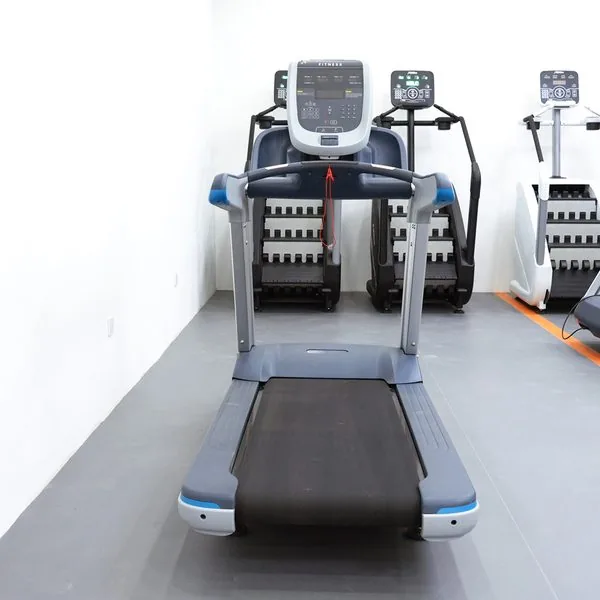
Two suppliers quote the same treadmill at the same FOB price. One says a 40HQ holds 62 units, the other says 48. Neither is lying, and the difference is not the machine — it is what each of them counted. One quoted the packed volume, the other quoted the assembled footprint. That gap is roughly twenty thousand dollars of freight sitting in a spreadsheet cell.
Container load is the least glamorous number in a gym equipment order and the one that decides whether a landed cost works. This article covers how to calculate it yourself, which four figures you need from the supplier, and the five places where the arithmetic usually goes wrong.
1. Measure the carton, never the machine
A treadmill occupies about 2.1 m × 0.9 m of floor when assembled. In its export carton it occupies far less, because the uprights and console are removed and the deck is folded. Those are two different numbers and only one of them matters for freight.
The figure you need is the outer carton dimension in centimetres, multiplied out to cubic metres:
Length (cm) × Width (cm) × Height (cm) ÷ 1,000,000 = cbm per unit
A carton of 210 × 90 × 45 cm works out to 0.851 cbm. A strength machine packed in 120 × 80 × 50 cm comes to 0.480 cbm. Note that a console removed and packed inside the same carton does not add volume — but a console packed as a separate box does, and that is one of the most common omissions.
Ask for three things per model, in writing: outer carton dimensions, gross weight per carton, and cartons per unit. If a machine ships as two cartons, the volumes add.
Container load answers "how much fits". It does not answer "who pays for what once it moves" — that is the freight terms question, and we set out the FOB, CIF, FCL and LCL trade-offs separately in shipping gym equipment from China.
2. The usable space in a 40HQ is not 76 cbm
The nominal capacity printed in freight tables is misleading. A 40-foot high cube has internal dimensions of roughly 12.03 m long, 2.35 m wide and 2.69 m high, giving a theoretical 76 cbm. What you can actually load is different for four reasons:
- The door opening is lower than the interior. The door height is around 2.58 m, not 2.69 m. Anything stacked above that line has to be loaded before the doorway, and in practice nothing goes there.
- The floor has rails and corrugation. The container floor is not flat to the wall; corrugated side panels and floor lashing rings eat a strip along each side.
- Cartons are rectangular solids, the floor plan is not. Uneven carton heights create dead air at the top. A realistic load leaves 10 to 15 per cent of the volume empty.
- Weight may bind before volume. A 40HQ has a maximum payload in the region of 26 tonnes, and some routes and road legs restrict it further. Steel-heavy loads can hit that limit with the container only two-thirds full.
A workable planning figure is 85 to 90 per cent of the theoretical volume for plain cartons, and 70 to 80 per cent for machines on timber frames or pallets, which do not nest. Using 67.6 cbm as the interior and applying 88 per cent gives about 59.5 cbm of practical capacity. That single adjustment explains most of the gap between two suppliers' quoted load counts.
3. Three ways to calculate, and when each applies
Volumetric method. Divide practical capacity by carton volume. Fast, and adequate for single-SKU orders. 59.5 ÷ 0.851 gives 69 treadmills by volume — but only if weight allows it, which brings the second check.
Weight cross-check. Multiply the unit count by gross weight and compare against the payload limit. At 69 units and 150 kg per carton, that is 10.35 tonnes — comfortably inside the limit, so volume governs. For a plate-loaded line where each carton weighs 220 kg, the same 69 units would be 15.2 tonnes, still fine. But a shipment of solid steel plates or heavy dumbbell sets often reverses the result, and the container ships half empty by volume.
Layout method. For mixed orders, sketch the floor plan. Usable floor length is about 12.0 m and width about 2.3 m, so you are fitting rectangles into 27.6 m². Two rows of 1.15 m width each, running the length of the container, is the standard arrangement — most gym equipment cartons are sized to sit two abreast. Then stack to the door height of 2.5 m. This is the only method that catches the awkward pieces: benches, small accessory cartons, and anything that cannot be stacked on.
4. Knock-down packing changes the number more than anything else
Most commercial strength machines ship semi-knocked-down: the frame arrives assembled, but the weight stack, guide rods, seat pads and shrouds are packed separately or removed. Full knock-down, where the frame is split into its main tubes, can raise the count per container substantially, but it shifts work to the destination — the buyer has to weld or bolt it back together, and the paint at the joints will never match a factory finish.
For a distributor with a warehouse and basic tools, semi-knocked-down is the sensible default. For a buyer taking a first order into a market with expensive labour, the assembled option is worth the freight. The point is to know which one is being quoted, because the same model can ship three ways with three different load counts.
5. The five places the arithmetic goes wrong
Mixed units
Carton dimensions arrive in millimetres from one supplier, centimetres from another, and inches from a third. A carton of 2100 × 900 × 450 is 0.851 cbm in millimetres and 850 cbm in centimetres. Always state the unit next to the number and convert before multiplying.
Timber frames measured on the inside
A machine on a timber frame is quoted at its frame's outer dimensions, because that is what takes up space in the container. Suppliers sometimes quote the carton inside the frame, which understates volume by 8 to 12 per cent. Ask which one it is.
Non-stackable items
Treadmill consoles, assembled benches and anything with a display on top cannot carry another carton. If half the order is non-stackable, effective capacity drops sharply and the volumetric method overstates the load by a wide margin.
Weight versus volume, ignored
Every load is limited by whichever comes first. Gym equipment spans the range: a treadmill is bulky and light, a dumbbell set is compact and heavy. A mixed container should be checked both ways, and heavy items placed at the bottom and toward the door end for axle weight.
Gross weight is worth a second look for another reason: on a strength machine it is one of the few honest signals of what is inside the frame. Two machines can look identical and differ by 30 kg of steel, which is why we treat steel tube wall thickness as a purchasing question rather than a technical detail.
Accessories counted inconsistently
Floor mats, spare cables, tool kits and assembly hardware are usually packed loose. They can easily add one to two cubic metres, which is two or three machines. Either include them in the calculation or confirm they are already inside the machine cartons.
6. What to put in the spec sheet
Four figures per model, and the argument disappears:
| Field | Example |
|---|---|
| Carton dimensions (L×W×H) | 210 × 90 × 45 cm |
| Gross weight per carton | 150 kg |
| Volume per unit | 0.851 cbm |
| Loading quantity per 40HQ | 69 units (volume-limited, 88% fill) |
The loading quantity should always state which constraint produced it. "69 units" on its own is not verifiable and cannot be checked against a second quote. "69 units at 88 per cent fill, volume-limited" tells the buyer exactly what assumption to challenge. The same rule applies to every other number on a spec sheet — if it carries no unit and no basis, it cannot be checked, which is the argument in how to read a commercial treadmill spec sheet.
7. A note on mixed containers
Most first orders are mixed: several cardio units, a run of strength machines, and a set of benches. Mixed loads almost always beat the sum of the individual calculations, because the leftover space above shorter cartons can absorb small items. But they can also beat it in the wrong direction if the heavy items are loaded last and the axle weight ends up illegal at destination.
The practical approach is to calculate each SKU at 90 per cent fill, add the volumes, then apply a further 5 per cent allowance for gaps between groups — and to load heavy items at the door end, over the axles, with lighter cartons toward the nose. This is standard practice for freight forwarders and worth confirming with yours before the container is packed, not after.
What this means when you are comparing quotes
If two suppliers give different container quantities for the same model, ask each of them four questions: is this the outer carton or the timber frame, is it semi-knocked-down or assembled, what fill percentage is assumed, and does it include the console and accessories. In most cases the difference resolves within those four answers, and where it does not, the lower number is usually the honest one.
Container load is not a marketing figure. Getting it wrong is paid for in freight, in demurrage, or in a second container for the last thirty machines.
If you need loading data for a specific model — carton dimensions, gross weight and confirmed units per 40HQ — send us the model numbers and we will return the packing table for each, along with the knock-down option and what it does to the count.