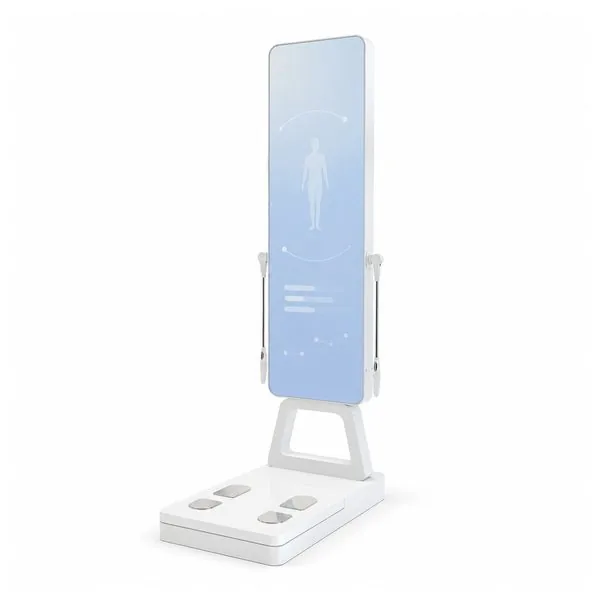
Search for a body scanner machine and you get three different industries mixed together: airport security, medical imaging, and the body assessment devices gyms actually put on their floor. A gym owner comparing full body scan machines is really asking one question: which machine can run member assessments all day, produce a report members trust, and justify its footprint and price?
This guide answers it the way we answer our own distributors: by technology type, by the specs that change the buying decision, by what drives body analyzer price, and by the questions to ask before you pay.
1. What a body scanner machine means in a gym context
In fitness, a body scanner is any device that captures a whole-body assessment and turns it into structured data: body fat, muscle mass, water distribution, posture or shape. Three families dominate quotations:
- BIA body composition analyzers — electrical measurement, two-minute tests, the commercial default.
- 3D optical scanners — camera-based body shape capture, strong on visual progress and circumference data, weaker on internal composition.
- DEXA and medical imaging — the clinical reference for research-grade accuracy, impractical for daily gym operation.
Most facilities that offer member assessments as a service land on BIA, because it is the only family that combines speed, zero consumables, no licence requirement and a report members act on.
2. The three technologies you will be quoted
Multi-frequency BIA. The machine reads how lean, water-rich tissue and fat-resistive tissue conduct currents differently. With 8-point contact it measures each limb and the trunk separately, producing 21-item composition reports plus — on screening models — posture assessment. Best for: gyms, studios, corporate wellness, weight-management programmes.
3D optical body scanners. Cameras reconstruct body surface geometry; the value is visual — members see shape change over weeks. It estimates composition indirectly from shape, so it complements rather than replaces a BIA analyzer. Best for: aesthetic-focused studios that sell visual progress.
DEXA. X-ray based, laboratory accuracy, clinical environment required. Impractical throughput for a gym floor and typically unavailable outside medical settings. Best for: research and clinical reference, not daily member testing.
3. What a commercial gym actually needs
Filter every quotation through four operational requirements:
- Throughput: a full assessment in about two minutes, with no repositioning — a rotating platform lets a member step on and stand still while the machine does the work. Peak-hour queues kill assessment programmes faster than any spec sheet.
- Reports that leave the building: A4 printing for the member, backend access for the coach, email delivery for the follow-up. Reports are retention tools; a number trapped in an app is not.
- Data continuity: cloud storage and multi-device sync so a member's history follows them across branches. Chains need this on day one.
- A service you can charge for: posture screening and body measurement turn a freebie scan into a billable assessment. Ask whether the posture module is included or optional.
4. Specification checklist: the five specs that matter
- Frequency count. Multi-frequency (5 / 20 / 50 / 100 / 250 kHz class) separates intracellular from extracellular water and stays stable across hydration. Single-frequency units drift.
- Electrode configuration. 8-point segmental contact is what produces limb-by-limb muscle balance. Without it you bought an expensive scale.
- Report depth. 21 composition items is the commercial standard; check that segmental, visceral fat and basal metabolic rate are all included.
- Connectivity. Cloud storage, face recognition for instant member lookup, OTA upgrades. Software ages faster than hardware — buy a platform, not a box.
- Physical fit. Confirm footprint against your floor plan and leave clearance for the platform and the operator. A 2100 × 680 mm unit like the TL880 needs a planned corner, not a leftover gap.
5. What drives body composition analyzer price
Quotations for a body composition analyzer machine vary more on software and sales channel than on hardware. Five factors move the number:
- Measurement hardware: frequency count and 8-point electrode systems are the core cost drivers; posture and 3D modules add another tier.
- Software and services: cloud platforms, report customization and update policies. Ask what is included for the life of the unit, not just year one.
- Branding: OEM/ODM units with your logo and report template usually cost little more at factory-direct terms and materially help a chain's brand consistency.
- Order volume: single-unit and fleet pricing differ sharply; multi-site operators should always quote quantities.
- Channel: the same body analyzer sold through a national distributor carries markup layers that a factory-direct quotation does not. This is typically the largest single difference between two quotations for the same hardware.
A practical rule: compare quotations on identical configuration, identical incoterms and identical report scope, then compare the supplier, not just the price.
6. Placement and workflow: where the machine goes
The best-selling layout we see: analyzer at the reception or assessment corner with clear sightlines, results reviewed at the coach's desk, and the printed report handed over at the exit path. One operator runs the whole flow; face recognition pulls the member's history without a search. Book assessments the same way you book classes — programmes that schedule scans retain members measurably better than programmes that rely on walk-ups.
7. Seven questions to ask before you pay
- How many measurement frequencies, and are they documented?
- Is segmental (8-point) reading standard or optional?
- What exactly is included in the report — itemize all 21+ items?
- Which parts of the software are paid after year one?
- Is the posture module hardware or software, and is it chargeable to my members?
- What is the lead time, packing size and freight split for my destination port?
- Can reports and housing be branded to my club under OEM terms?
Suppliers who answer these in writing are the ones worth shortlisting.
8. The short answer
For a commercial gym, the right body scanner machine is a multi-frequency, 8-point BIA analyzer with printed and cloud reporting — fast enough for peak hours, deep enough to feed a coaching programme, and priced factory-direct. Compare the TL880 flagship and TL870 touchscreen model, or send us your country and quantity for a specification-matched body composition analyzer price.