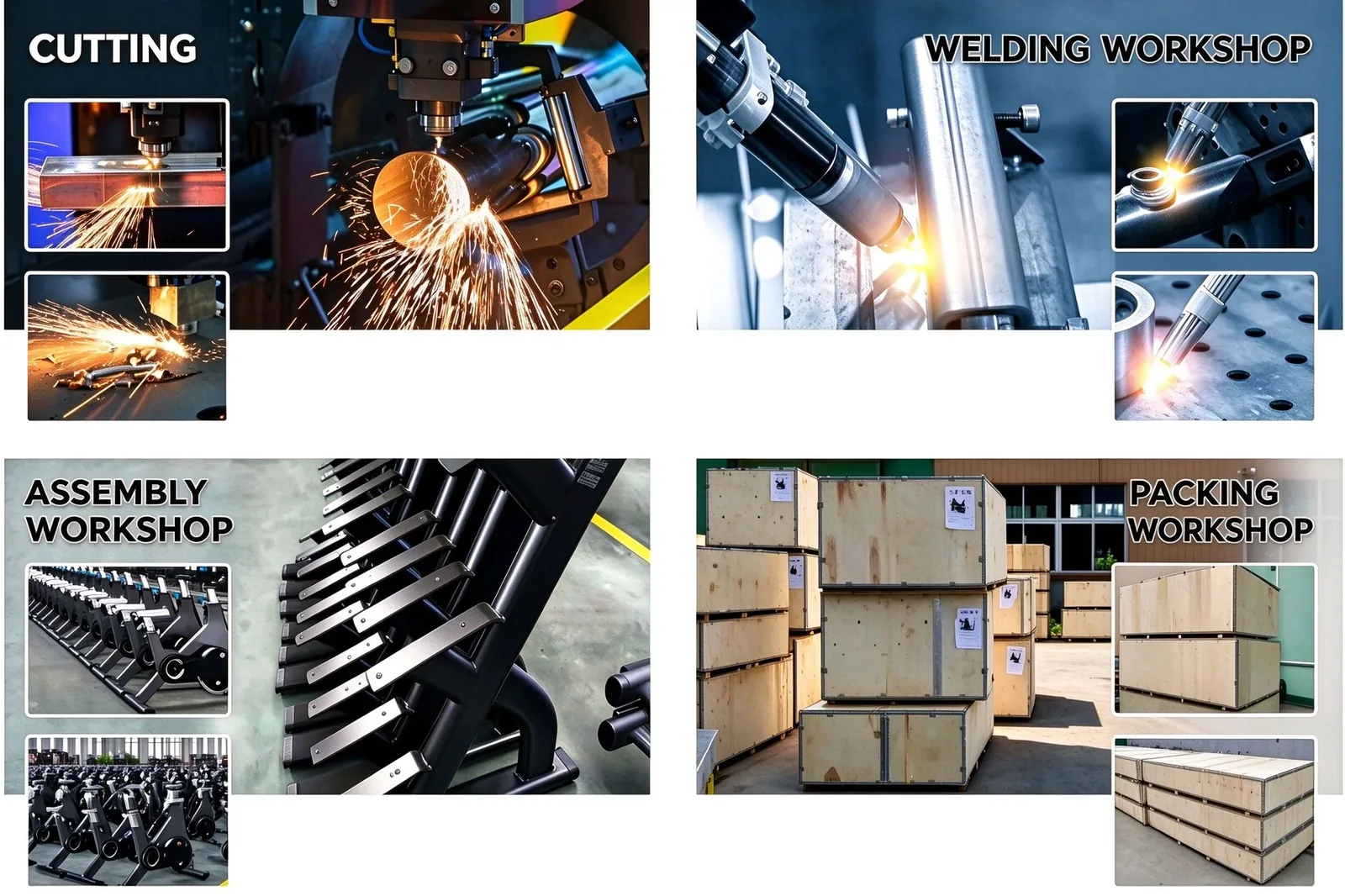
Most buyers who ask for a factory video are checking two things: are there real machines here, and is the floor clean. Both are the easiest things in the world to arrange. A trading office can borrow a workshop for an afternoon, tidy it, line up finished units, and produce a video that passes every casual test.
The parts of a plant that resist that treatment are not the machines or the floor. They are the gaps: the queue of cut tubes waiting at the welding bay, the fixtures that hold a frame square while it is tacked, the bins of fasteners sorted by length, the log sheet on the test bench that was filled in this morning. None of those are impressive to photograph, which is exactly why they are worth looking at.
This is a station-by-station guide to a fifteen-minute live call, organised around the five processes and, more importantly, the four transitions between them. It assumes you have already decided to ask for the call; the reasoning behind that decision is covered in our ten-point audit checklist.
1. Why the transitions carry more information than the stations
A production line is a queue. Material enters as tube, passes through cutting, welding, coating, assembly and testing, and leaves as a packed machine. The stations are fixed: every gym equipment factory has a welding bay and an assembly area, and they all look broadly similar. What differs is the logic of the queue — how much material sits between stations, in what state, and in which direction it is moving.
That logic is set by a production plan and by the physical layout of the building. It cannot be assembled in an afternoon, because assembling it would mean moving several tonnes of steel into positions that only make sense if work has been flowing through them for weeks. This is the asymmetry a buyer can exploit: everything that is cheap to stage is also weakly informative, and everything that is expensive to stage is the thing you actually want to see.
Practical rule for the call: spend two-thirds of your attention on the twenty seconds after each station ends, not on the station itself.
2. Cutting: what the tube ends tell you
Before you look at the machine doing the cutting, look at what it has produced. Cut tube is the raw evidence of the whole downstream process.
Ask the camera to hold on a stack of cut pieces. What you are reading:
- The cut face. A saw cut leaves a flat face with visible tool marks; a laser or plasma cut leaves a narrow kerf and a cleaner edge. Either is legitimate. What is not legitimate is a stack of pieces with wildly different cut angles — that means the stop gauge is not being used, and every frame from that batch will need to be pulled square during welding.
- Deburring. Look for a deburring station, even a simple one. Burrs left inside a tube become a coating defect and a rust point.
- Wall thickness. If the specification says 2.5 mm and the offcut looks like sheet metal, ask them to put a caliper on it on camera. This is a normal request and takes ten seconds. A supplier who becomes uncomfortable here has told you something.
- Offcuts and scrap. Real production generates short ends and swarf. A spotless cutting area with no scrap at all usually means the area was swept for the call, which means the area was staged.
Transition to watch: the distance between the cutting area and the welding bay. If cut tube is stacked beside the welding bay in trolleys or stillages, work is flowing in batches. If the two areas are at opposite ends of the building with nothing in between, either the plant is idle or the tube is being moved by hand one piece at a time — both worth asking about.
3. Welding: the fixtures are the evidence
This is the most informative station on the tour, and almost nobody looks at the right part of it.
Watch the weld bead for twenty seconds and you learn whether the welder is competent. Watch the fixture for twenty seconds and you learn whether the factory builds this model repeatedly.
A welding jig — the frame of clamps and stops that holds tubes in position while they are tacked — is heavy, purpose-made, and specific to one geometry. It is also, in a real plant, visibly used: spatter on the stops, burn marks, shims, a worn patch where the operator clamps. Building a convincing jig for a model you do not produce is expensive and pointless, so jigs are the single hardest thing in a factory to fake on short notice.
What to ask the camera to show:
- Two or three different jigs, and which model each one is for. A factory producing eight models has fixtures for those eight; a trading desk showing someone else's floor cannot explain the rack.
- The bead on a joint up close. Look for consistency, a clean toe line, and no grinding marks over the weld — grinding a weld is often a repair.
- Spatter and cleanup. Some spatter is normal; anti-spatter spray and a chipping hammer at the station tell you the process is managed rather than improvised.
- Who is welding. One person at one bench is a demonstration; three or four stations with different people at different stages is a schedule.
The question that sorts the call: while the camera is at the welding bay, ask "which model is this batch for, and how many units?" Then ask a second question about the same batch two minutes later, from a different part of the floor. A person standing in the production flow answers both consistently. Someone relaying from an office, or reading from a prepared script, does not.
4. Coating: the invisible stage
Powder coating is where a walkthrough most often goes quiet, because the interesting part happens before the paint and cannot be filmed attractively.
Pre-treatment — phosphating, shot blasting, or an acid wash — is what determines whether the finish survives a coastal gym for five years or fails at the first scratch. Ask to see the pre-treatment area even though it is ugly. Questions worth asking:
- Is there a phosphate or blasting stage at all, or is the part coated straight off the weld bench?
- Are parts hung on a line, and do the hooks carry accumulated coating from previous batches? Heavy buildup on hooks is one of the best proofs of continuous operation, because it takes months to accumulate.
- Is the oven temperature and line speed recorded anywhere, and can they show the log?
- What is the coating thickness specification, and is it measured or assumed?
Transition to watch: freshly coated parts should be visibly present — hanging, still warm, with bare contact points where the hooks touched. A coating area with no parts in it, next to a showroom of finished machines, tells you the machines were coated somewhere else.
5. Assembly: the bins say more than the benches
Assembly is the stage most easily staged, because it is the stage that looks like work in any photograph. Three details cut through that.
Fastener bins. A real assembly area has open bins of bolts, washers and nyloc nuts, sorted by size, with the bins half-empty and refilled from a stock carton. If every fastener in the building is in a sealed bag labelled with the model number, you are looking at kitting for a photo, not a working line.
Torque tools. Frame bolts and cable terminations have specified torque. A plant that assembles commercially rated equipment should have torque wrenches or preset pneumatic drivers in use at the bench, not a standard spanner. Ask to see one being used, and ask what the setting is.
Work in progress. Half-assembled machines with cables not yet routed, a stack waiting for a missing part, a unit on a trestle with the console hanging loose — this is what assembly looks like at any given moment. A row of finished, gleaming units with nothing in between is a showroom.
Transition to watch: where do the finished machines go? If they go straight to a testing area with a queue, the plant tests everything. If they go straight to packing with no test station visible anywhere on the route, ask where testing happens — and be sceptical if the answer is "on request".
6. Testing: the station nobody volunteers
This is the stage to ask for by name, because it is the one that gets skipped in a prepared tour.
For motorised equipment, a run-in test means the machine is powered, the belt is tracked and tensioned, speed and incline are cycled, and the console is checked — all of which takes minutes per unit and cannot be done convincingly in a two-second shot. For strength equipment, testing is a load check plus a full travel check of the mechanism, and cable tensioning on selectorized units.
What to look for in that area:
- A powered test position with a machine on it, running.
- A written test log with today's date. Ask them to hold the sheet to the camera. A blank template proves nothing; a filled sheet with yesterday's entries proves the station is used.
- A quarantine or rework area. A plant with no failed units anywhere is more suspicious than one with a small tagged pile, because every real production line produces some rework.
- Who signs off. A named inspector with a stamp or signature against the batch is a system; a verbal "we check everything" is not.
7. Packing: where the delivery damage is decided
Packing deserves its own two minutes, because a large share of the complaints buyers file in the first month are decided here, not in the workshop.
Ask the camera to walk the packing area and show:
- The protection actually used on a packed unit — foam corner blocks, stretch film, edge board, and for heavy frames, a plywood or slatted crate.
- Bulk packaging stock in the building. Rolls of film and stacks of cartons in quantity indicate regular packing; two rolls on a shelf indicate occasional packing.
- Shipping marks on a carton. If the cartons carry another customer's brand or a different consignee, ask whose shipment that is.
- Container loading, if any is happening. How units are braced and whether dunnage is used tells you what your own delivery will look like.
8. How to run the fifteen minutes
The call works better as a fixed route than as a conversation. Send this before the call, so nobody has to improvise:
- One continuous shot, walking forward — cutting, welding, coating, assembly, testing, packing. No cuts, no second camera, no switching to stills.
- Stop twice: once at a weld joint for a close look, once at the packing area to see how a finished machine is protected.
- Hold on the in-between areas for twenty seconds each. Those are the parts you are actually evaluating.
- Answer three questions on the floor: which model is this batch; how many units; who checks it before packing.
- Record the call with their agreement, and note the time on the clock at the start.
Fifteen minutes is enough. A plant needs no preparation to walk its own floor, which is why "no preparation needed" is the fairest way to frame the request — and why a supplier who asks for three days to prepare has answered a question you did not ask.
9. Six things that mean the tour was arranged
- The route starts and ends in the same meeting room.
- The workshop is silent, with no machine noise anywhere.
- The guide will not step outside a defined corridor.
- Questions about the current batch are answered by someone off-camera.
- "The signal is bad here" exactly at the transition you asked to see.
- Finished units in a neat row with no work in progress anywhere on the route.
None of these proves anything alone. Two of them together mean the deposit is premature.
10. After the call: three cross-checks
A video is evidence only if it can be tied to a place and a supplier. Three checks close the loop:
- Location and signage — ask for a live location share during the call, and for the gate sign to be filmed with the street visible. If the location does not match the address on the quotation, that is the finding.
- Model consistency — the machines on the floor should be the models being quoted to you, not a different family with a familiar logo.
- Document consistency — the entity name on the business licence and the bank account should match the name on the quotation. A mismatch here turns every other piece of evidence into an open question.
Related reading: the 10-point factory audit checklist before your deposit · commercial vs semi-commercial vs home treadmills · gym equipment warranty explained: frame, motor, parts and labour.
If you would like to run this route on our floor, send us a time window and we will set up a live call — cutting, welding, coating, assembly, testing and packing in one continuous shot, with the jigs, the work-in-progress and the test bench log shown as they are on the day, not as they look after a day of preparation.